
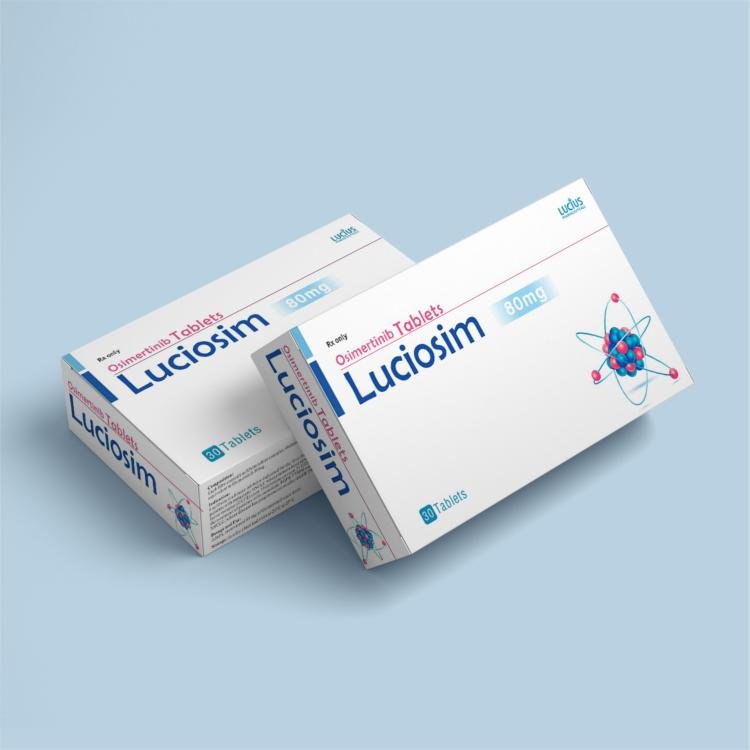
Product details
HIGHLIGHTS OF PRESCRIBING INFORMATION
These highlights do not include all the information needed to use LuciOsim safely and effectively. See full prescribing information for LuciOsim.
INDICATIONS AND USAGE
LuciOsim is a kinase inhibitor indicated for:
• as adjuvant therapy after tumor resection in adult patients with non-small cell lung cancer (NSCLC) whose tumors have epidermal growth factor receptor (EGFR) exon 19 deletions or exon 21 L858R mutations, as detected by an FDA-approved test.
• the first-line treatment of adult patients with metastatic NSCLC whose tumors have EGFR exon 19 deletions or exon 21 L858R mutations, as detected by an FDA-approved test.
• the treatment of adult patients with metastatic EGFR T790M mutation-positive NSCLC, as detected by an FDA-approved test, whose disease has progressed on or after EGFR TKI therapy.
DOSAGE AND ADMINISTRATION
Adjuvant treatment of early-stage NSCLC: 80 mg orally once daily, with or without food, until disease recurrence, or unacceptable toxicity, or for up to 3 years.
Metastatic NSCLC: 80 mg orally once daily, with or without food, until disease progression or unacceptable toxicity.
DOSAGE FORMS AND STRENGTHS
Tablets: 80 mg×30 tablets
CONTRAINDICATIONS
None.
WARNINGS AND PRECAUTIONS
• Interstitial Lung Disease (ILD)/Pneumonitis: Occurred in 3.8% of patients. Permanently discontinue LuciOsim in patients diagnosed with ILD/Pneumonitis.
• QTc Interval Prolongation: Monitor electrocardiograms and electrolytes in patients who have a history or predisposition for QTc prolongation, or those who are taking medications that are known to prolong the QTc interval. Withhold then restart at a reduced dose or permanently discontinue LuciOsim.
• Cardiomyopathy: Occurred in 3% of patients. Conduct cardiac monitoring, including left ventricular ejection fraction (LVEF) assessment in patients with cardiac risk factors.
• Keratitis: Promptly refer patients with signs and symptoms of keratitis to an ophthalmologist for evaluation.
• Erythema Multiforme Major, Stevens-Johnson Syndrome, and Toxic Epidermal Necrolysis: Withhold LuciOsim if erythema multiforme major (EMM), StevensJohnson syndrome (SJS), or toxic epidermal necrolysis (TEN) is suspected and permanently discontinue if confirmed.
• Cutaneous Vasculitis: Withhold LuciOsim if cutaneous vasculitis is suspected, evaluate for systemic involvement, and consider dermatology consultation. If no other etiology can be identified, consider permanent discontinuation based on severity.
• Aplastic Anemia: Withhold LuciOsim if aplastic anemia is suspected and permanently discontinue LuciOsim if confirmed.
• Embryo-Fetal Toxicity: LuciOsim can cause fetal harm. Advise females of potential risk to the fetus and to use effective contraception during treatment with LuciOsim and for 6 weeks after final dose. Advise males to use effective contraception for 4 months, after the last dose of LuciOsim.
ADVERSE REACTIONS
Most common (>20%) adverse reactions, including laboratory abnormalities were leukopenia, lymphopenia, thrombocytopenia, diarrhea, anemia, rash, musculoskeletal pain, nail toxicity, neutropenia, dry skin, stomatitis, fatigue, and cough.
DRUG INTERACTIONS
Strong CYP3A Inducers: Avoid if possible. If not possible, increase LuciOsim to 160 mg daily in patients receiving a strong CYP3A4 inducer.
USE IN SPECIFIC POPULATIONS
Lactation: Do not breastfeed.
Storage
Store at 20℃ to 25℃ (68℉ to 77℉), excursions permitted between 15℃ and 30℃ (59℉ and 86℉) [see USP Controlled Room Temperature]. Protect from moisture.
Reviews
There are no reviews yet.